
Weimar and Buchenwald
Shadow and Renewal in Anthroposophy

The Goetheanum’s 2022–2023 Anthroposophical Studies Program included a class trip to Weimar and Buchenwald, in Germany. Our diverse cohort, representing every continent, met in Switzerland to study and contribute to Anthroposophy’s unfolding. In these places, we encountered essential considerations for its past, present, and future.
Weimar is pristine, a cherished heritage of German culture that profoundly shaped Rudolf Steiner in his youth. Viewing the bed in which Goethe died, the room in which he wrote, the garden house he retreated to, the river he swam in—we become intimate with Goethe. Just as we meet an author through their work or art, we meet them through the places they inhabit. Past energies linger in spaces, objects, and artifacts, serving as portals to what occurred and, through connecting to the past, to what futures might unfold. Though less thoroughly, we also visited sites tied to Schiller and Nietzsche, figures important not only for Weimar’s story but to Rudolf Steiner as well.
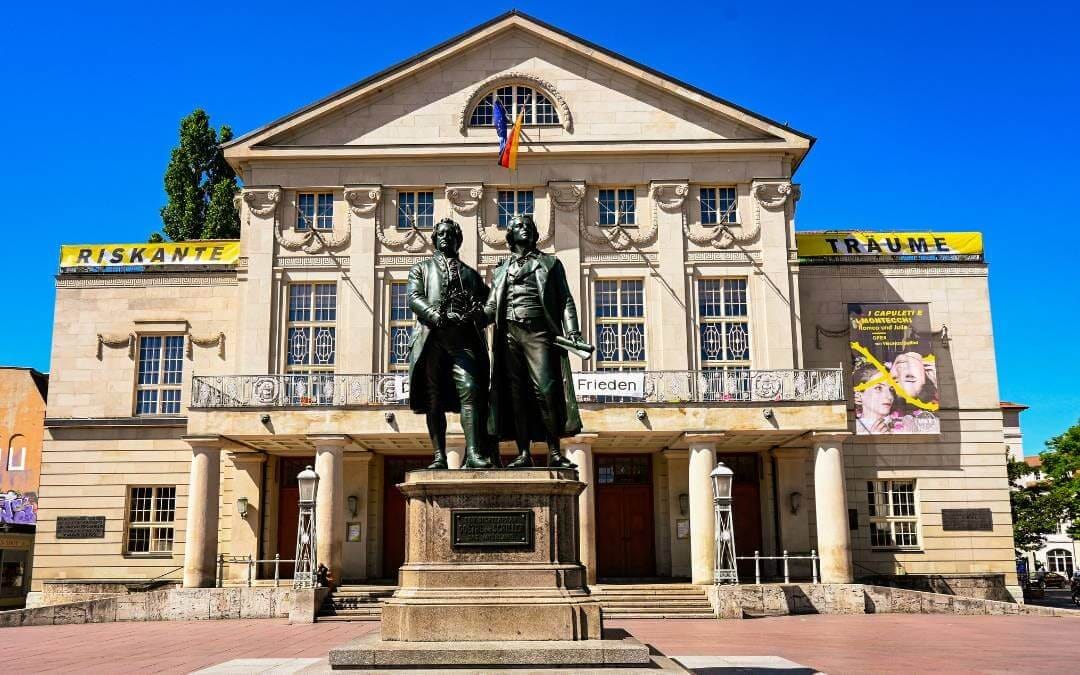
We traced every place in Weimar where Steiner lived, even his first brief stay in an apartment overlooking the garden wall of Goethe’s house. Peter Selg’s biography helped prepare us. I was touched that Steiner arrived in Weimar at roughly my current age then, thirty-one, and struggled intensely during those years. What a relief to know he faced such deep internal discontent in his thirties, when I had half-expected life to feel more “figured out” by now.
From Steiner’s letters, we learn he felt profoundly lost during his time in Weimar; longing to contribute virtue to a society unprepared to receive and acknowledge his gifts. His early writings met rejection from academic circles; a professorship never materialized. Looking back, it is striking that a man of such potential devoted so many years largely to editing and organizing the work of others. What patience it must have required of Steiner to balance his own momentous mission with the stewardship of other’s legacies. It is incredible that a key culminator of German Idealism’s gifts should arrive at one of its greatest heritage sites only to encounter profound difficulty. Knowing Germany’s 20th-century trajectory, and Weimar’s symbolic role in the Third Reich, perhaps Steiner’s suffering was as much with the future as with the past.
Just outside of Weimar we visited the Buchenwald concentration camp. Here we bore witness to the violent reality of World War II and the corruption of the human soul. I felt horror at the despair and humiliation endured by victims, yet found myself perceiving more acutely the consciousness that enabled the perpetrators. Then it struck me—these perceptions of perpetrators and victims alike are self-perception. Fear, hatred, and doubt are potentials within all humanity, shadows that can overtake the soul.
This horror echoed in my own story through the genocide, theft, and brutalization of Native Americans. Fellow students reflected on traumas from their own homelands. How can these histories be healed when the consciousness that created it is not over yet?
In Buchenwald, civilians endured violence, humiliation and starvation: dying behind fences while guards went about living their lives. This dynamic of deprivation and dehumanization continues today, as in Gaza, where innocent women and children starve to death.
Through initiation science, every human being becomes parent to every child—beyond nation, tribe, or heredity. Love will not permit the fallacy of separation. The being of love demands no less.
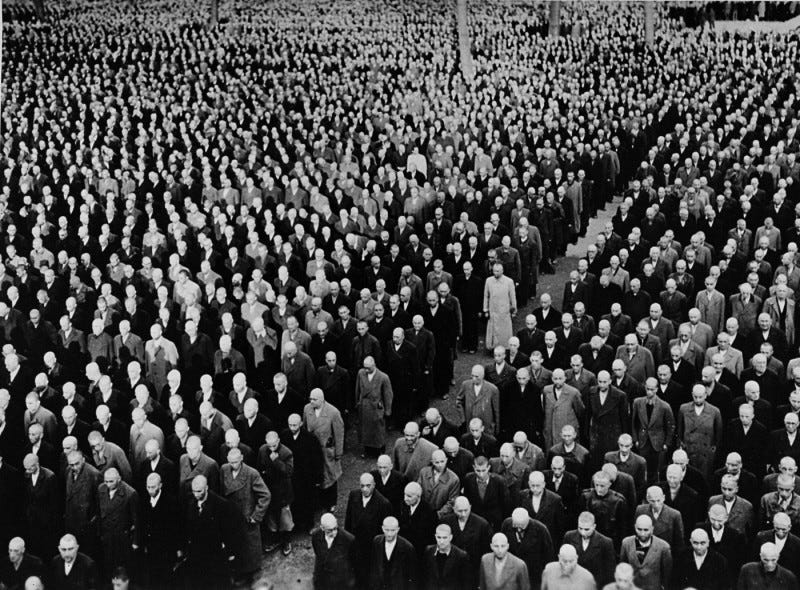
Returning from Buchenwald’s forested outskirts to Weimar, we saw how the Nazis claimed the city as a spiritual center, their large buildings still looming. This juxtaposition—of Weimar’s creative, idealistic spring flowing through Steiner and Anthroposophy, and then into the concentration camp—awakened me to how much of the Anthroposophical Society and its initiatives still inhabit a pre-World War II consciousness. It’s easy, immersed in Steiner’s writings, to overlook how profoundly events after Rudolf Steiner’s death in 1925 have reshaped Central Europe.
Steiner himself adapted immensely to the transformation of conditions after World War I. So we must imagine that the results of Steiner’s spiritual research, particularly his indications about the mission of European folk souls, have evolved over the past century.
Steiner spoke of Central Europe as a potential spiritual center for our age, with German as the globally utilized spiritual language akin to Sanskrit in earlier epochs. The catastrophic historical events of the 20th century after Rudolf Steiner’s death suggest that any assumed role that Central Europe and the German language could have must be reexamined, not presumed.
Rudolf Steiner came to fulfill the modern mission of Central Europe just before the entire world forsook all things Central European in disgust of the Nazis. Anthroposophy became a diamond in the rough—a light before a time of greatest darkness.
Weimar revealed the greatness of the Central European gift; Buchenwald demonstrated how severely the circumstances had changed. In the aftermath, nationalism becomes a great hindrance for the Anthroposophical Movement, rather than a condition through which something greater could be born. We must honor and continue the gifts of Rudolf Steiner—cosmic wisdom—and not over-sympathize with the vehicle: culture.
When radiant light,
Meets the darkness of the abyss,
Morality,
By way of color,
Can become.
"When radiant light, meets the darkness of the abyss, morality, by way of color, can become."
This is such a more beautiful way of saying "there are shades of grey." It harkens to 12 perspectives as well.
One of the great challenges today is the loss of nuance (color) in the cultural dialog. When there is so much noise, it hard to hear the quiet (inner?) voices speaking truth.
Michaelic times indeed :D
Beautiful reflections, Ezra. Thanks you.